
Factors Affecting Entrepreneurship Growth: The Complete Guide for Startups, Policymakers, and Investors
Entrepreneurship growth depends on a few big things working together: strong market demand, access to money, smart regulation, skills and talent, and reliable technology and infrastructure. When these pieces fit, startups form faster, survive longer, and scale into job-creating businesses. When even one piece breaks like credit access or permits, growth slows down. In this guide, I’ll break down the most important factors affecting entrepreneurship growth, with real-world examples and practical ways to act on them.
Factors affecting entrepreneurship growth: the “big picture” ecosystem
Entrepreneurship does not grow in a vacuum. It grows in an ecosystem. Think of it like farming: great seeds help, but you still need good soil, water, sunlight, and time.
Over the past 10 years working with founders, I’ve noticed something consistent: people love to blame one thing when growth stalls. They blame “the algorithm,” the economy, investors, or competition. Sometimes those things matter. But most of the time, growth slows because two or three ecosystem parts fail at once.
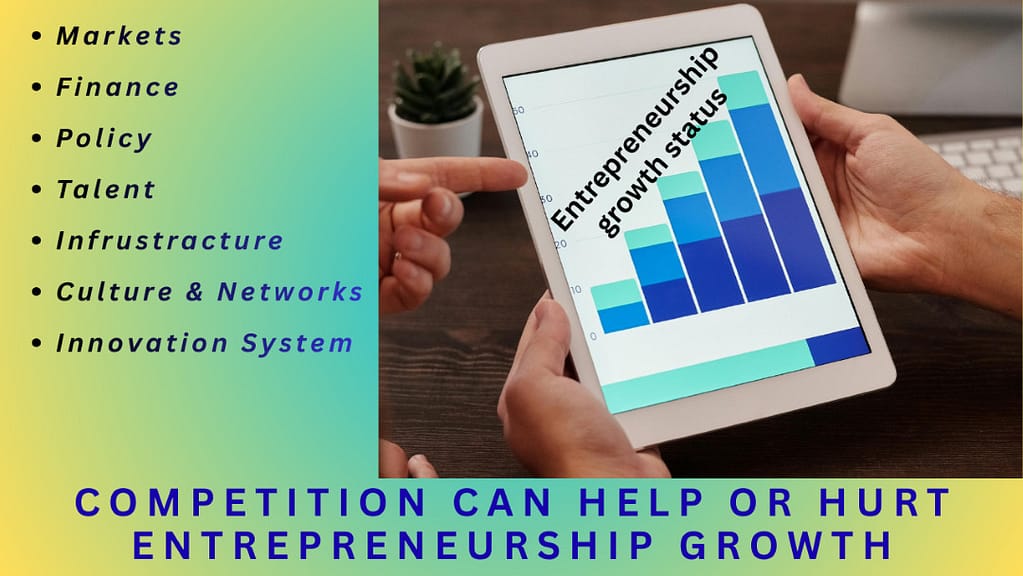
Here’s the ecosystem view of the factors affecting entrepreneurship growth:
- Markets: customers who can pay, clear needs, and reachable demand
- Finance: savings, credit, investors, and payment systems
- Policy: rules that make starting, operating, and scaling predictable
- Talent: founder skills, hiring pipelines, and management capacity
- Infrastructure: internet, logistics, power, transport, industrial capacity
- Culture & networks: trust, mentorship, role models, and social support
- Innovation system: universities, R&D, clusters, and knowledge transfer
When you improve one factor, you often improve others too. For example, better digital payments can expand markets and help businesses qualify for loans through transaction history.
Economic and market factors affecting entrepreneurship growth
Consumer demand, purchasing power, and market size
If customers can’t pay, growth can’t happen. This sounds obvious, but many entrepreneurs skip it when they fall in love with an idea.
Key market forces that drive entrepreneurship growth:
- Purchasing power: Higher incomes usually support more new business creation and faster scaling.
- Market size: Larger addressable markets support more competition and specialization.
- Market access: Can you reach customers through retail channels, digital ads, distributors, or partnerships?
- Stability: Extreme inflation or currency swings can crush planning and pricing.
Personal insight: I’ve seen founders build a “great product” for an audience that agrees it’s cool, but won’t actually pay. Once the founder changes the target customer to someone with a real budget, growth starts to look “easy” (it isn’t easy, but it becomes possible).
Practical checks:
- Can your ideal customer buy this without financing?
- Do you solve a problem tied to revenue, cost, risk, or status?
- Is your pricing matched to how your customers earn and spend?
Competition, pricing pressure, and market maturity
Competition can help or hurt entrepreneurship growth.
- In early markets, you may need to educate customers. That slows growth.
- In mature markets, customers already understand the category. That can speed adoption, but pricing pressure rises.
Healthy competition often signals a real market. But if the market has “winner-takes-most” dynamics (strong network effects), new entrants may struggle without a clear niche.
Signs the market structure supports growth:
- Customers can switch providers (low lock-in)
- Distribution channels are open (not controlled by one giant)
- Customers compare options and still pay for differentiation
Access to finance factors affecting entrepreneurship growth
Money fuels hiring, inventory, product development, and marketing. It also helps businesses survive bad months. That’s why access to finance is one of the most important factors affecting entrepreneurship growth.
Bank lending, collateral, and working capital (credit constraints)
Traditional lending often fails entrepreneurs because banks want:
- collateral
- stable cash flows
- long operating history
Many startups have none of those early on.
This isn’t just a “founder problem.” It’s a system issue. The International Finance Corporation (IFC) has documented how large the SME finance gap is globally and how credit constraints limit small business growth, especially for underserved groups (like women-owned firms). You can explore the data and framing in IFC’s report on the MSME finance gap.
Ways better credit access supports entrepreneurship growth:
- Inventory and equipment financing increases output
- Working capital prevents stock-outs and missed contracts
- Credit history helps firms formalize and scale
Founder moves that improve your odds:
- Keep clean bookkeeping from month one
- Separate personal and business accounts
- Build transaction history (invoicing, payment rails)
- Start with the smallest credit product you can repay reliably
Angel investors, venture capital, and “risk capital” availability
VC is not the only funding source, but it matters in innovation-heavy sectors (software, biotech, advanced manufacturing). Availability of risk capital depends on:
- local investor networks
- exit opportunities (acquisitions, IPOs)
- legal frameworks (shareholder rights, reporting)
- talent density (teams investors trust)
Personal insight: When founders ask me how to “get investors,” I often tell them to focus on two things first:
- a clear wedge into a market (a simple, narrow first win)
- proof that customers pay (even small payments count)
Investors fund momentum. Momentum comes from customers.
Public funding, grants, and blended finance
Grants can help early-stage innovation, especially in:
- climate tech
- health
- education
- research-heavy products
But grants can also create a trap if founders shape the business only around grant requirements. The healthiest pattern: use grants to de-risk R&D, then pivot quickly to customer-funded growth.
Policy and regulatory factors affecting entrepreneurship growth
When rules are clear and enforcement is predictable, entrepreneurs take more risks. When rules are confusing or corrupt, entrepreneurs stay small or stay informal.
Business registration, licensing, and compliance time (regulatory barriers)
The time and cost to start and operate a business matters. If it takes months to register, get permits, or open a business bank account, fewer people start and more stay informal.
The World Bank’s work on a strong business enabling environment highlights how regulatory frictions can affect firm creation and scaling. See the World Bank’s overview of business-enabling environment reforms and diagnostics.
What helps entrepreneurship growth:
- one-stop registration
- simple licensing
- transparent fees
- digitized government services
Personal insight: I once worked with a small services firm that could have hired five more people quickly. But the owner delayed because compliance felt like a maze. When they finally got an advisor and a simple checklist, they hired within 60 days. The business didn’t change. The friction did.
Taxes, labor rules, and the cost of formalization
Taxes matter, but the bigger issue is often complexity:
- unclear filings
- unpredictable audits
- many small fees across agencies
Entrepreneurship growth improves when governments:
- simplify filing
- reduce time cost
- offer clear small-business regimes
- support compliance digitally
Labor rules also play a role. If hiring is risky or termination rules are unclear, small businesses hesitate to add staff.
Contract enforcement, property rights, and trust
Entrepreneurs scale through contracts: supplier agreements, leases, client deals, employment terms. If the system can’t enforce contracts fairly, founders avoid long-term commitments.
This impacts:
- B2B growth (hard to close big deals)
- lending (hard to secure collateral)
- partnerships (higher risk)
Strong institutions help markets trust each other. Trust speeds up commerce.
Education, skills, and talent factors affecting entrepreneurship growth
Founders’ skills: sales, finance, leadership, and execution
A lot of entrepreneurship content focuses on vision and mindset. Those matter. But practical skills drive growth:
- Sales: talking to customers, handling objections, closing deals
- Marketing: clear positioning and consistent lead flow
- Finance: pricing, margins, cash flow, and runway
- Operations: delivery, quality control, and hiring
- Leadership: setting priorities and building culture
Personal insight: The best “growth hack” I’ve seen is boring: one founder improves their sales skill and runs a simple pipeline every week. That alone can double revenue faster than any fancy tool.
Workforce skills and talent pipelines
Entrepreneurship growth also depends on the talent available for hiring. If a region lacks:
- developers
- technicians
- sales leaders
- supply chain managers
- skilled trades
…businesses hit a ceiling.
The World Economic Forum’s competitiveness research connects growth capacity to pillars like skills, infrastructure, and innovation capability. You can find these reports in the WEF reports library, including competitiveness-focused publications: World Economic Forum reports.
When talent pipelines improve, startups can:
- ship faster
- reduce costly errors
- improve customer service
- compete globally

Technology and infrastructure factors affecting entrepreneurship growth
Internet access, payments, logistics, and cloud tools
In 2026, entrepreneurship growth increasingly relies on basics like:
- stable internet
- affordable smartphones/devices
- digital payments
- delivery/logistics networks
- reliable electricity
- cloud software access
If any of these are weak, businesses spend time “fighting the environment” instead of serving customers.
Examples of how infrastructure impacts growth:
- Poor logistics increases delivery times and returns.
- Weak payment rails reduce conversion and limit online sales.
- Unreliable power raises costs and hurts quality.
WEF’s work on infrastructure and competitiveness helps frame why these basics matter for productivity and scaling capacity: World Economic Forum reports.
Innovation ecosystems: universities, R&D, incubators, clusters
Entrepreneurship growth accelerates when regions build:
- university-industry links
- incubators and accelerators
- research commercialization offices
- startup clusters where talent and capital concentrate
The OECD’s Entrepreneurship at a Glance series often covers firm dynamics and entrepreneurship indicators across countries, helping explain how policy and ecosystem design influence startup creation and survival: OECD Entrepreneurship at a Glance.
What clusters do well:
- speed up hiring through dense networks
- increase mentorship access
- increase investor attention
- improve knowledge spillovers
Culture, networks, and social factors affecting entrepreneurship growth
Risk tolerance, stigma of failure, and role models
Culture shapes who starts businesses and how ambitious they feel they can be.
If failure carries heavy stigma, entrepreneurs
- avoid experimentation
- stay small
- avoid formal borrowing
- hide problems until it’s too late
If role models are visible, people think, “Someone like me can do this.”
The Global Entrepreneurship Monitor (GEM) tracks entrepreneurial intentions and ecosystem conditions across countries and shows how motivations (opportunity vs necessity) differ by context. Browse recent reports here: GEM Global Reports.
Mentorship, networks, and diaspora effects
Networks reduce the cost of learning. A good mentor can save you months.
Networks help entrepreneurs:
- find first customers
- hire trusted people
- access supply chains
- get investor introductions
Personal insight: I’ve watched two similar founders take totally different paths. One stayed isolated and learned everything the hard way. The other joined a small founder community, got warm intros, and improved faster. Same talent. Different network.
Operational and firm-level factors affecting entrepreneurship growth (what founders control)
A lot of ecosystem factors sit outside a founder’s control. But many of the biggest growth levers are internal.
Product-market fit and customer feedback loops
Product-market fit means customers want your product enough that selling feels repeatable.
Signals you’re getting closer:
- customers refer others without being asked
- churn drops (people stick around)
- sales cycles shorten
- price resistance decreases
How to build fast feedback loops:
- talk to customers weekly
- track 3–5 key metrics
- run small tests before big launches
- write down objections and answer them in marketing
Team, processes, and basic financial discipline
Entrepreneurship growth often breaks at “messy middle” stages:
- too many tasks, no process
- weak managers
- unclear roles
- cash leaks
Simple systems that help:
- weekly cash flow review (not monthly)
- documented core processes (sales, delivery, support)
- basic KPIs on one dashboard
- clear hiring scorecards
Go-to-market, distribution, and partnerships
Distribution is a growth multiplier.
Common distribution channels:
- direct sales
- e-commerce
- marketplaces
- channel partners/resellers
- enterprise procurement
- local distributors (for physical goods)
Personal insight: Many founders overbuild product features and underbuild distribution. If you’re not growing, look at your distribution engine first. A “good enough” product with strong distribution often beats a perfect product with weak distribution.
Factors affecting entrepreneurship growth in developing countries (special focus)
Many of the same drivers apply everywhere, but developing contexts often have stronger constraints.
Informality, infrastructure gaps, and limited credit history
Challenges that show up more often:
- businesses operate informally to avoid complexity
- weak logistics and power reliability raise costs
- limited credit bureaus or thin-file customers restrict lending
- fewer local buyers for high-priced products
- talent shortages in specialized roles
This is why the finance and infrastructure pillars show up again and again in global research like the IFC’s MSME finance gap and competitiveness frameworks from the WEF.
Policy priorities that unlock growth fastest
If policymakers want to support entrepreneurship growth, the highest-leverage moves often include:
- simplify registration and licensing
- digitize compliance
- improve contract enforcement
- expand digital ID and payment systems
- support SME credit products and guarantee schemes (carefully designed)
- invest in skills training aligned with industry needs
The World Bank’s business enabling environment work provides a helpful way to frame these reforms: World Bank business enabling environment.
Measuring entrepreneurship growth (so you don’t guess)
One reason people argue about entrepreneurship is that they measure different things. “More startups” is not always “more growth.” Some startups form because people can’t find jobs (necessity entrepreneurship). Others form because people see a strong opportunity.
Common measures used in research and policy:
- new business entry rates / business density
- survival rates (1-year, 3-year, 5-year)
- scale-ups (firms that grow jobs or revenue rapidly)
- productivity (output per worker)
- innovation outputs (patents vary by sector)
The OECD’s Entrepreneurship at a Glance is one of the best starting points for understanding these indicators and cross-country comparisons: OECD Entrepreneurship at a Glance. The GEM reports also help separate entrepreneurial activity by motivation and ecosystem constraints: GEM Global Reports.
Quick diagnostic: a simple way to assess the factors affecting entrepreneurship growth
Use this table like a basic health check. Score each factor from 1 (weak) to 5 (strong). Then circle the lowest two—those are your biggest constraints.
| Factor affecting entrepreneurship growth | What “5” looks like | Score (1–5) |
| Market demand | Clear customer need + ability to pay | |
| Access to finance | Working capital available at fair terms | |
| Regulation | Fast registration + predictable compliance | |
| Talent & skills | Hiring pipeline + strong management | |
| Infrastructure | Reliable internet, power, logistics, payments | |
| Culture & networks | Mentors, role models, strong founder community | |
| Innovation support | Incubators, R&D links, cluster effects |
How to use the result:
- If market demand is lowest: fix targeting, pricing, positioning.
- If finance is lowest: tighten bookkeeping, build transaction history, explore alternative financing.
- If regulation is lowest: get professional compliance help, join a business association, advocate for simplification.
- If talent is lowest: invest in training, simplify processes, hire generalists early.
- If infrastructure is lowest: design around constraints (offline-first, local warehousing, redundancy).
Practical strategies to improve entrepreneurship growth (founder + ecosystem view)
Founders can do in the next 30 days:
- Interview 10 customers and write down patterns
- Build a simple weekly sales pipeline report
- Track cash flow weekly and cut one unnecessary cost
- Improve one core process (delivery, onboarding, support)
- Join one founder network or local business group
Investors and accelerators can do:
- Provide structured mentorship (not just pitch days)
- Help startups build financial systems early
- Introduce credible distribution partners
- Support follow-on capital readiness
What policymakers can do (without “picking winners”)
- Cut time to register and license
- Digitize tax and filing systems for micro and small businesses
- Improve payment infrastructure and digital identity
- Expand access to credit responsibly and transparently
- Invest in skills programs tied to employer demand
Final thoughts: entrepreneurship growth is built, not wished into existence
If you want to understand the factors affecting entrepreneurship growth, don’t look for one magic answer. Look for the bottleneck. Markets, money, rules, skills, infrastructure, and culture all work together. Fix the weakest link, and the whole system moves.
If you want, tell me your country/region and what kind of business you mean (retail, services, SaaS, manufacturing). I can tailor the “top constraints” list and the 30-day action plan to your context.
FAQs: Factors affecting entrepreneurship growth
- What are the most important factors affecting entrepreneurship growth?
The biggest factors are market demand, access to finance, regulation quality, skills and talent, and infrastructure (digital + physical). Culture, networks, and innovation systems also matter, especially for high-growth sectors.
- How does access to finance affect entrepreneurship growth?
Finance helps firms buy inventory, hire staff, and survive slow months. When credit is scarce or expensive, businesses grow slower and stay smaller. The IFC’s MSME finance gap explains how widespread these constraints are and why they limit small business expansion.
- How do government policies and regulations impact entrepreneurship growth?
Clear and simple rules reduce the time and cost of starting and operating a business. Complex systems push businesses into informality and limit scaling. The World Bank’s work on business enabling environments explains how better regulation supports firm growth.
- What role do education and skills play in entrepreneurship growth?
Skills help founders sell, manage money, hire, and execute. Workforce skills also affect how easily startups can scale. Competitiveness frameworks, including skills and innovation capability pillars, show up in reports from the World Economic Forum.
- How do technology and infrastructure influence entrepreneurship growth today?
Reliable internet, payments, power, and logistics reduce costs and increase reach. They also enable e-commerce and new business models. Infrastructure and innovation readiness are core themes in the World Economic Forum reports and entrepreneurship indicator work like OECD Entrepreneurship at a Glance.
About The Author