10 Best Books on Financial Independence for Beginners (Ranked by What to Read First)
TL;DR: Most people never achieve financial independence because nobody taught them the rules of money. The right books fix that fast. This post ranks the 10 best books on financial independence for beginners, ordered by what you should read first based on where you are right now. Whether you’re drowning in debt or just starting to invest, this list gives you a clear reading path, not just another pile of titles to feel guilty about ignoring.
Here’s a question worth sitting with: if you know you should be saving and investing, why aren’t you doing it at the level you know you should be?
Most people don’t have an effort problem. They have a knowledge gap, and that gap is expensive. According to the 2025 TIAA Institute-GFLEC Personal Finance Index, U.S. adults answered only 49% of basic financial literacy questions correctly. That number has not budged in nearly a decade. And this knowledge gap comes at a real cost. The National Financial Educators Council found that financial illiteracy cost the average American $948 in 2025 alone.
That’s not a math problem. That’s a financial education problem.
The best books on financial independence for beginners exist to close that gap, but reading them in the wrong order can leave you more confused than when you started. Some books are built for people with zero savings. Others assume you already have a solid foundation. Jumping into the wrong one first is like trying to run before you’ve learned to walk.
This ranked list fixes that. You’ll know exactly what to read, in what order, and why each book belongs where it does on this list. If you’re serious about building wealth in the digital economy, this is one of the highest-return investments you can make.
What Makes a Great Financial Independence Book for Beginners?
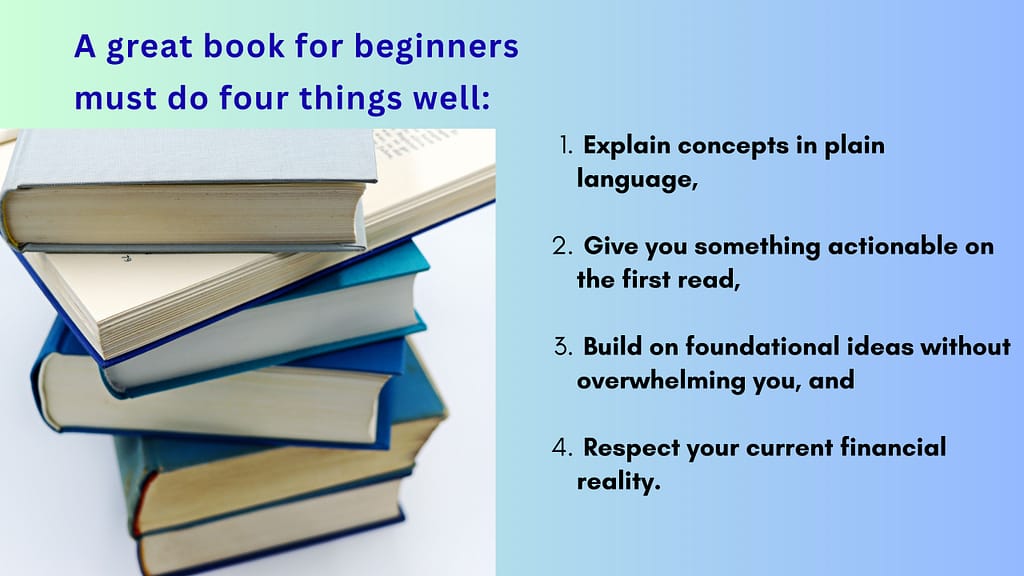
Not every personal finance book belongs on a beginner’s reading list. A great book for beginners must do four things well: explain concepts in plain language, give you something actionable on the first read, build on foundational ideas without overwhelming you, and respect your current financial reality, wherever that is.
Before diving into the list, it helps to understand how these books were ranked. Four criteria drove every placement:
1. Readability: Can a complete beginner finish this book without a finance degree? Books that require prior knowledge of investing concepts, tax strategy, or advanced math were ranked lower or excluded.
2. Actionability: Does the book give you something specific to do when you close it? A mindset shift is valuable, but a book that also gives you a step-by-step system earns a higher spot.
3. Sequence logic: Some books build the foundation. Others build the walls. A few add the roof. The ranking reflects which books need to come first so the later ones actually land.
4. Real-world applicability: Financial theory is only useful if you can apply it to your actual life. Books ranked highest are the ones where readers consistently report changing their behavior, not just their thinking.
Here’s a quick-reference table before we go deep on each one:
| Rank | Title | Author | Difficulty | Best For |
| 1 | The Total Money Makeover | Dave Ramsey | Beginner | Getting out of debt fast |
| 2 | I Will Teach You to Be Rich | Ramit Sethi | Beginner | Automating your money |
| 3 | Your Money or Your Life | Vicki Robin | Beginner/Intermediate | Rethinking your relationship with money |
| 4 | Rich Dad Poor Dad | Robert Kiyosaki | Beginner | Mindset shift on assets vs. liabilities |
| 5 | The Millionaire Next Door | Thomas Stanley | Beginner/Intermediate | Understanding real wealth behavior |
| 6 | The Automatic Millionaire | David Bach | Beginner | Building wealth on autopilot |
| 7 | The Simple Path to Wealth | JL Collins | Intermediate | Index fund investing for FI |
| 8 | Set for Life | Scott Trench | Intermediate | Aggressive early wealth building |
| 9 | A Random Walk Down Wall Street | Burton Malkiel | Intermediate | Understanding markets and investing |
| 10 | Die with Zero | Bill Perkins | Intermediate/Advanced | Optimizing spending across your life |
The 10 Best Books on Financial Independence for Beginners, Ranked by Reading Order
Book 1: The Total Money Makeover by Dave Ramsey
If you have debt, this is where you start. Full stop.
The Total Money Makeover gives you a concrete, step-by-step plan to eliminate debt and build a starter emergency fund before you even think about investing. Ramsey’s “Baby Steps” framework has helped millions of people stop the financial bleeding, and it’s one of the most widely recommended starting points in the personal finance world for good reason.
What it’s about: Ramsey breaks your financial life into seven sequential steps, starting with saving $1,000 as a starter emergency fund, then attacking all debt using the debt snowball method (paying off smallest balances first), building a full 3-6 month emergency fund, and eventually investing and building wealth. The language is direct. The plan is simple. It works.
Who it’s best for: Anyone carrying consumer debt, student loans, or car payments who feels like they’re spinning their wheels financially. If you’re starting from a deficit, this book gives you a proven exit ramp.
Key takeaway: You cannot build lasting wealth on a shaky foundation. Get out of debt first, then invest. The sequence matters more than the speed.
Why it’s ranked first: Before any investing strategy makes sense, you need breathing room. Debt is the single biggest drag on financial independence for most beginners, and Ramsey’s system is one of the clearest roadmaps for eliminating it.
Book 2: I Will Teach You to Be Rich by Ramit Sethi
Once your debt situation is under control (or if you’re starting with little to no debt), Ramit Sethi’s book is the next essential read.
What it’s about: Sethi, a Stanford-educated personal finance expert, gives you a six-week program to automate your finances, set up the right bank accounts, maximize credit card rewards, start investing in low-cost index funds, and negotiate your bills. He writes for people in their 20s and 30s, but the system works at any age. The tone is refreshingly honest: he doesn’t shame you for spending money on things you love. He just helps you build systems so the important stuff happens automatically.
Who it’s best for: Beginners who are debt-free or close to it and want a practical, modern system for managing money without obsessing over every dollar.
Key takeaway: Automation beats willpower every time. Build a system where saving and investing happen before you can spend the money, and the rest of your financial life gets dramatically easier.
Why it’s ranked second: Sethi bridges the gap between “getting out of debt” and “actually investing.” Most beginners stall here because they don’t know what to do next. This book answers that question clearly.
Book 3: Your Money or Your Life by Vicki Robin
What is “Your Money or Your Life” Really Teaching You?
Your Money or Your Life by Vicki Robin is a foundational book on financial independence that reframes money as a representation of your life energy, not just numbers in an account. It asks you to calculate how much of your life you’re trading for each purchase, which fundamentally changes how you spend and save. It’s one of the books that genuinely shifts how you think, not just what you do.
I’ll be honest: when I first picked up this book, I expected another budgeting manual. What I got instead was a completely different way of thinking about work, spending, and what “enough” actually means. That shift alone was worth more than any specific financial tactic I’ve learned since.
What it’s about: Robin introduces the concept of “life energy,” the idea that every dollar you spend represents a certain number of hours you had to work to earn it. The book walks you through a nine-step program to track your spending, align your money with your values, and reach a point called “the crossover point” where your investment income covers your living expenses. That’s financial independence, described in human terms rather than spreadsheet terms.
Who it’s best for: Anyone who feels like they’re working too hard for too little freedom, or who has the technical knowledge to save but hasn’t found the emotional motivation to actually do it.
Key takeaway: Financial independence isn’t about a number in a bank account. It’s about reclaiming your time, and this book is the clearest explanation of that idea ever written.
Why it’s ranked third: After you’ve handled debt and automated your finances, this book deepens your “why.” And without a strong “why,” most people give up on the FI journey before they get anywhere near the finish line.
Book 4: Rich Dad Poor Dad by Robert Kiyosaki
Rich Dad Poor Dad has sold over 32 million copies worldwide, and while it’s polarizing in some personal finance circles, the core mindset shift it delivers is genuinely valuable for beginners.
What it’s about: Kiyosaki tells the story of growing up with two father figures: his own father (educated, employed, financially struggling) and his best friend’s father (less formally educated, entrepreneurial, wealthy). Through this contrast, he teaches the difference between assets (things that put money in your pocket) and liabilities (things that take money out). He argues that the wealthy buy assets first and that financial education is more important than academic education.
Who it’s best for: Beginners who have been raised to think of a stable job as the only path to security. This book challenges that assumption in a way that’s accessible and story-driven.
Key takeaway: Your financial future is built on what you own and what generates income for you, not just on how much your paycheck says.
Why it’s ranked fourth: This book plants the mindset seeds that every later book in this list will water. Read it after you’ve taken your first practical steps, so the mindset shift reinforces action rather than replacing it.
Book 5: The Millionaire Next Door by Thomas Stanley
What Does “The Millionaire Next Door” Reveal About Real Wealth?
The Millionaire Next Door by Thomas Stanley is a research-backed study of how actual millionaires in America build and maintain wealth. The core finding: most wealthy people live well below their means, avoid flashy spending, and prioritize financial independence over social status. The book challenges almost every assumption beginners have about what wealthy people look like and how they got there.
What it’s about: Stanley spent years surveying and interviewing millionaires across the United States. What he found surprised almost everyone. The average millionaire drives a used car, lives in a modest house, and invests consistently. They don’t look rich. They just are rich. The book is packed with data showing that wealth is almost never the result of a high income alone. It’s the result of consistent habits practiced over years.
Who it’s best for: Anyone who conflates income with wealth, or who thinks that looking successful and being successful are the same thing. This book is a reality check and a motivator at the same time.
Key takeaway: Wealth is what you don’t spend. The people quietly building financial independence around you probably don’t look like what you’d expect.
Why it’s ranked fifth: After the mindset work of books 3 and 4, Stanley’s research grounds you in reality. It shows you what the actual path to financial independence looks like in real households, not hypothetical ones.
Book 6: The Automatic Millionaire by David Bach
The Automatic Millionaire is one of the most practically useful books on this list for people who know what they should be doing but keep failing to do it consistently.
What it’s about: Bach introduces the concept of “paying yourself first,” specifically through automated contributions to retirement and savings accounts before you ever see the money. He also popularized the concept of the “Latte Factor,” the idea that small, daily discretionary spending adds up to significant lost wealth over time. His core argument is that you don’t need a budget or willpower if your financial system is set up correctly.
Who it’s best for: Beginners who struggle with consistency. If you keep meaning to save more but find the money disappears before you get around to it, Bach’s automation-first approach solves that problem directly.
Key takeaway: The best financial system is one you don’t have to think about. Automate everything, and let compounding do the heavy lifting over time.
Why it’s ranked sixth: By this point in your reading journey, you understand the mindset and the basic mechanics. Bach gives you the operational system to lock it all in automatically.
Book 7: The Simple Path to Wealth by JL Collins
Is “The Simple Path to Wealth” Really That Simple?
The Simple Path to Wealth by JL Collins is the clearest explanation of index fund investing for financial independence ever written. Collins argues that investing doesn’t need to be complicated, and that a simple portfolio of low-cost index funds will outperform almost every other strategy over the long term. For beginners stepping into investing for the first time, this book removes the fear and the confusion in a way no other book on this list does quite as well.
The data backs Collins up completely. According to the SPIVA U.S. Scorecard (Year-End 2023), approximately 95% of actively managed large-cap funds underperformed the S&P 500 index over a 20-year period. You don’t need to be a stock-picking genius. You just need to own the whole market at the lowest possible cost.
What it’s about: Collins, who originally wrote these ideas as letters to his daughter, explains the stock market in plain language, why it always goes up over long periods despite short-term crashes, how to invest in total market index funds through Vanguard or similar providers, and how a high savings rate combined with simple investing leads to financial independence faster than almost any other approach.
Who it’s best for: Beginners who are ready to start investing but feel intimidated by the stock market. Also essential for anyone who has been paying for actively managed funds without realizing the cost.
Key takeaway: Own a simple index fund, keep costs low, contribute consistently, and don’t panic when the market drops. That’s the entire strategy. Everything else is noise.
Why it’s ranked seventh: You need the mindset (books 1-4) and the behavioral systems (books 5-6) before this one lands properly. Read this too early and the investment concepts feel abstract. Read it here and everything clicks.
Book 8: Set for Life by Scott Trench
Set for Life by Scott Trench (CEO of BiggerPockets) is one of the most practical books on aggressive early wealth building ever written for young adults. It’s where the reading list shifts from foundational to strategic.
What it’s about: Trench lays out a three-phase plan for building financial independence in your 20s and 30s. Phase one focuses on cutting your biggest expenses drastically (usually housing). Phase two focuses on building skills and income. And phase three focuses on investing in assets, particularly real estate, to generate passive income. He’s direct about the sacrifices involved, but equally direct about the results they produce.
Who it’s best for: Younger readers who want to accelerate their path to financial independence and are willing to make aggressive short-term lifestyle adjustments to get there faster.
Key takeaway: Your three biggest expenses (housing, transportation, food) determine your financial trajectory more than almost anything else. Optimize those first, then invest the difference.
Why it’s ranked eighth: This book works best once you have a solid financial foundation and a clear investment philosophy. It gives you the acceleration strategy after you’ve built the base.
Book 9: A Random Walk Down Wall Street by Burton Malkiel
A Random Walk Down Wall Street by Burton Malkiel is the most academically rigorous book on this list, and it earns its place because of one core argument that every investor needs to understand.
What it’s about: Malkiel, a Princeton economist, argues that stock prices follow a “random walk,” meaning that past price movements tell you nothing reliable about future performance. He systematically dismantles technical analysis, stock-picking strategies, and market timing, then makes the case for passive index fund investing with the depth of a scholarly economist. Updated regularly since its original 1973 publication, the book remains one of the most cited works in personal finance.
Who it’s best for: Beginners who want to understand why index investing works at a deeper level, or anyone tempted by active trading, crypto speculation, or “hot stock” tips.
Key takeaway: Markets are more efficient than most people believe. The most reliable path to investment returns is to stop trying to beat the market and simply own it.
Why it’s ranked ninth: This book provides the intellectual foundation that makes your commitment to index investing unshakeable. After Collins introduces the strategy, Malkiel explains the decades of evidence behind it.
Book 10: Die with Zero by Bill Perkins
What Does “Die with Zero” Mean for Financial Independence Seekers?
Die with Zero by Bill Perkins challenges one of the core assumptions of the financial independence movement: that accumulating as much as possible is always the goal. Perkins argues that money only has value when it’s used, and that dying with a large unspent nest egg represents a failure to live fully, not a success. The book is a philosophical counterweight to the rest of this list, and reading it last is intentional.
What it’s about: Perkins, a hedge fund manager, makes the case for optimizing life experiences across your entire lifespan rather than deferring all enjoyment until retirement. He introduces concepts like “memory dividends” (the returns you get on life experiences through memories) and argues that there are windows in your life when experiences are most valuable. He’s not arguing against saving. He’s arguing for intentional spending in the right seasons of life.
Who it’s best for: Readers who have internalized the FI concepts from the earlier books but want a framework for thinking about when and how to actually use their wealth, not just accumulate it.
Key takeaway: Financial independence is not the finish line. It’s the starting line for a life designed around what matters most to you.
Why it’s ranked last: This book only makes sense after you’ve built a solid financial foundation. Read it too early and it can be used as a rationalization for not saving. Read it here and it becomes a powerful framework for living intentionally on your path to FI.
How to Read These Books Without Feeling Overwhelmed
The biggest threat to your financial education is not picking the wrong book. It’s reading without acting, and then feeling so overwhelmed by the pile of books you haven’t read yet that you don’t do anything at all.
Here’s what I’ve found actually works: read one book per month and implement one idea before you pick up the next one.
That’s it. One book. One action. Then repeat.
If you finish The Total Money Makeover and you don’t set up your $1,000 emergency fund before starting I Will Teach You to Be Rich, you’ve consumed information without creating change. The books on this list build on each other, but the real compounding happens when knowledge meets action.
A few practical reading habits that help:
Take notes in your own words. After each chapter, write two or three sentences about what you learned and what you’re going to do about it. Don’t copy the author’s words. Translate their ideas into your situation.
Read with a specific financial goal in mind. Before you open book one, write down your current financial situation: income, debt, savings, and your biggest financial fear. Update it after each book. Watching your situation change is the most motivating thing you can do.
Don’t skip ahead. The ranking exists for a reason. Reading The Simple Path to Wealth before you’ve read The Total Money Makeover is like studying advanced calculus before you understand basic algebra. The later books assume knowledge the earlier ones give you.
Exploring practical finance strategies alongside your reading keeps the concepts connected to real-world application, which is where the real learning happens.

The Biggest Mistakes Beginners Make When Reading Financial Independence Books
Reading financial independence books is one of the smartest things a beginner can do. But a few common mistakes turn a powerful learning tool into an expensive form of procrastination.
Mistake 1: Reading without acting
This is the most common and most costly mistake. Reading about compound interest without actually investing is the same as reading about exercise without going to the gym. Knowledge only creates wealth when it’s applied. Set a rule: before you finish any book on this list, take one concrete financial action based on what you read.
Mistake 2: Reading advanced books before foundational ones
Jumping straight to A Random Walk Down Wall Street or Die with Zero without reading the foundational books first is a fast way to feel confused and give up. The books ranked 1-3 exist to build the mental and practical framework that makes the later books make sense. Skip them and you’re building on sand.
Mistake 3: Treating contradictory advice as a reason to do nothing
Dave Ramsey tells you to pay off debt before investing. Ramit Sethi says contribute to your 401(k) to get your employer match even while paying off debt. Both are right, depending on your situation. Contradictions in financial advice aren’t a flaw. They’re a feature. Different strategies work at different life stages. Use the reading order here to understand the context behind each approach.
Mistake 4: Using books as a substitute for action
According to Gallup research (2023), 57% of Americans don’t have a written budget. Most of them know they should have one. More reading won’t solve that. At some point, you have to close the book and open a spreadsheet.
Mistake 5: Ignoring books that challenge your current beliefs
The books on this list will challenge things you think you know about money, wealth, and success. That discomfort is the point. The readers who get the most out of this list are the ones who stay curious even when an author’s perspective challenges their assumptions.
What Is Financial Independence and How Does It Work?
Financial independence means having enough passive income or accumulated wealth that you no longer need to work for money unless you choose to. It doesn’t mean being a millionaire. It means that your money works hard enough that you don’t have to. The most common benchmark used in the FI community is the 25x rule: save and invest 25 times your annual expenses, and you can live off a 4% annual withdrawal indefinitely.
Financial independence became mainstream through what’s now called the FIRE movement, which stands for Financial Independence, Retire Early. The core idea is simple: spend less than you earn, invest the difference aggressively, and reach a point where work becomes optional. The timeline varies, but most people who pursue FI seriously reach it in 10-25 years depending on their savings rate and income.
This matters for beginners because financial independence isn’t a concept reserved for high earners or finance professionals. According to data from the Bureau of Economic Analysis 2026, the average personal savings rate in the U.S. is around 2.6%. That’s far below the 20-30% savings rate that most FI practitioners consider a minimum starting point.The gap between 2.6% and 20% isn’t a math problem. It’s a knowledge and mindset problem. That’s exactly what these 10 books solve.
If you want to connect the FI concepts in these books to growing your income alongside your savings, the combination of those two levers is where the real acceleration happens.
What’s the Single Best Financial Independence Book to Start With?
The best financial independence book for most beginners to read first is The Total Money Makeover by Dave Ramsey if you have any consumer debt. If you’re debt-free and already saving, start with I Will Teach You to Be Rich by Ramit Sethi instead. Both books are written for complete beginners, give you specific action steps, and build the foundation that every other book on this list depends on.
Here’s the simple decision tree:
Start with Book 1 (The Total Money Makeover) if:
- You have credit card debt, student loans, or car payments
- You feel like you’re working hard but never getting ahead
- You want a clear, structured plan before anything else
Start with Book 2 (I Will Teach You to Be Rich) if:
- You’re mostly debt-free
- You want to start investing but don’t know how to set up a system
- You’ve heard the basics before but never actually implemented them
After that, follow the ranked order on this list. The sequence is the strategy.
Financial Independence Books vs. Courses and Podcasts: What Actually Works?
The personal finance space is crowded with courses, podcasts, YouTube channels, and social media accounts all promising to teach you about money. So why are books still the best starting point for most beginners?
Books force slower, deeper processing. Reading a book requires active engagement in a way that passively listening to a podcast or watching a video doesn’t. Research by Lusardi and Mitchell (Journal of Economic Literature, 2014) found that financial literacy is directly correlated with better wealth accumulation and retirement outcomes. The mechanism matters: people who engage actively with financial content make better long-term decisions than those who consume it passively.
Books have higher information density. A 250-page book on financial independence contains ideas that would take years of podcast episodes to cover with the same depth. You can get the core principles of financial independence from 10 books in less time than it would take to binge enough podcasts to cover the same ground.
Books are more reliable. Publishers Weekly (2023) reported a 12% increase in personal finance book sales in 2023, driven partly by readers seeking depth over the noise of social media finance content. A well-researched book goes through editorial review in a way that a TikTok video or podcast episode doesn’t.
That doesn’t mean podcasts and courses have no value. Once you’ve built your foundational knowledge through books, tools like AI tools that accelerate your financial planning become genuinely useful supplements. But they work best when you already have a framework to evaluate what you’re hearing.
Think of books as your foundation. Everything else is insulation.
Your Next Move Starts With One Book
Here’s what this list comes down to: you don’t need to read all 10 books before you make any financial progress. You need to read the right book first, take one action, and build from there.
If you have debt, open The Total Money Makeover today. If you’re debt-free and saving inconsistently, start with I Will Teach You to Be Rich. Either way, start this week, not when you feel more ready.
Three things to remember as you work through this list:
- The reading order is the strategy. These books were ranked to build on each other. Trust the sequence.
- Implementation beats consumption. One action taken beats three books read and filed away.
- Financial independence is available to ordinary people. The books on this list prove it repeatedly with real data, real stories, and real systems.
The J.D. Power U.S. Investor Satisfaction Study (2025) found that investors with higher financial knowledge score significantly better on long-term satisfaction and wealth outcomes. The books on this list are how you build that knowledge.
Your path to winning in the digital economy starts with the decision to invest in your financial education. That investment pays dividends for the rest of your life.
Start with book one. Take one action. Then keep going.
Frequently Asked Questions
1. What is the best financial independence book for an absolute beginner?
The best financial independence book for an absolute beginner depends on one thing: whether you have debt. If you carry consumer debt (credit cards, student loans, or car payments), start with The Total Money Makeover by Dave Ramsey. It gives you a clear, step-by-step plan to eliminate debt before you do anything else. If you’re already debt-free, start with I Will Teach You to Be Rich by Ramit Sethi, which teaches you how to automate your savings and begin investing in plain, beginner-friendly language.
2. How long does it take to achieve financial independence?
The timeline to financial independence varies widely based on your savings rate, income, and expenses. The most commonly cited benchmark in the FIRE community is the 4% rule, which says you need to save 25 times your annual expenses. Someone saving 10% of their income might take 30-40 years to reach FI. Someone saving 40-50% could get there in 10-15 years. According to data from the Bureau of Economic Analysis 2026, the average American saves only about 2.6% of their income, which means most people are on a 40+ year timeline without a deliberate change in strategy.
3. Can reading books alone make you financially independent?
No. Books provide the knowledge and the framework, but financial independence is built through consistent action over time. Reading without implementing is one of the most common mistakes in personal finance. The most valuable use of any book on this list is to read it, identify one actionable step, take that step, and then move to the next book. Knowledge only creates wealth when it’s applied to real decisions: how much you save, where you invest, and how you spend.
4. What is the FIRE movement and is it realistic for beginners?
FIRE stands for Financial Independence, Retire Early. It’s a movement built around the idea of saving and investing aggressively to reach a point where work becomes optional, often decades before traditional retirement age. It’s realistic for beginners, but requires a significant shift in savings behavior. The FINRA National Financial Capability Study (2025) found that only 27% of Americans can answer five out of seven basic financial questions correctly, which means most beginners start from a knowledge deficit. The books on this list address that gap directly and give you a practical path into the FIRE framework at whatever pace fits your life.

Chalchisa Dadi is the founder of Rejoice Winning — a platform built for ambitious people who refuse to be left behind in the digital economy. With over a decade of hands-on experience analysing and implementing business plans for both private and public enterprises, Chalchisa brings a rare combination of strategic depth, real-world execution, and analytical precision to every piece of content published on this site.
Holding a verified certification in Data Analysis and Artificial Intelligence Fundamentals from Udacity, Chalchisa sits at the intersection of business strategy, financial intelligence, and emerging technology — the exact three pillars that power Rejoice Winning. Every insight shared here is grounded in years of working directly with organisations to turn ideas into measurable, sustainable results.
Chalchisa created Rejoice Winning with a single conviction: that winning in the digital economy is not reserved for the privileged few. It is a deliberate outcome available to anyone willing to learn strategically, move decisively, and build consistently. That mission drives every article, every guide, and every resource published on this platform.