15 Best Personal Finance Books for Beginners in 2026 (Ranked by Financial Goal)
TL;DR: Most personal finance book lists give you the same titles in random order with no context. This guide ranks 15 of the best personal finance books for beginners in 2026 by the financial goal they actually solve: getting out of debt, building a budget, starting to invest, or building long-term wealth. Pick the book that matches your biggest money problem right now. That single decision will move you faster than reading ten books at random.
Most people know they need to get better with money. But when it comes to actually sitting down with a personal finance book, the options feel overwhelming. Walk into any bookstore (or scroll through Amazon) and you’ll find hundreds of titles all promising to change your financial life.
Here’s the uncomfortable truth: according to the TIAA Personal Finance Index 2024, American adults correctly answer only 48% of personal finance questions on average. That’s barely half. Financial stress is also one of the leading sources of anxiety for Americans across every income level, according to Pew Research Center data. And yet, the best personal finance books for beginners in 2026 are more accessible, more practical, and more beginner-friendly than ever before.
The problem isn’t a shortage of great books. The problem is knowing which one to read first.
This guide solves that. Instead of giving you a generic ranked list, we’ve matched 15 of the best personal finance books to the specific financial goal they solve best. Find your goal. Start your book. Build from there. If you want more than books, our personal finance insights cover the practical side of everything you’ll read about here.
Why Most Personal Finance Book Lists Fail Beginners
Most “best personal finance books” lists are built the same way. They take the most popular titles on Amazon, add a one-paragraph summary, and call it a day. The problem is that a book perfect for someone trying to escape $40,000 in credit card debt is completely wrong for someone who’s debt-free and trying to start investing.
The FINRA National Financial Capability Study (NFCS, 2024) found that only 34% of U.S. adults could answer four out of five basic financial literacy questions correctly. That’s not a knowledge problem in terms of access. There are thousands of great resources available free. It’s a direct problem. People don’t know which information applies to them right now.
Reading the wrong book at the wrong financial stage is genuinely discouraging. I’ve seen this pattern play out repeatedly: someone reads “Rich Dad Poor Dad” when what they actually needed was a debt-elimination system. They finish it feeling inspired but with no concrete action to take. So they read another book. And another. The books pile up on the nightstand while the credit card balance stays exactly where it is.
The National Endowment for Financial Education has found that financial education leads to measurable improvements in savings behavior and debt management, but only when the education matches the learner’s current financial reality. That’s exactly the framework this guide uses.
If you’re working on building financial literacy from the ground up, the goal-based approach you’ll see below will save you months of reading the wrong things at the wrong time.
What Is the Best Personal Finance Book for a Complete Beginner in 2026?
The single best personal finance book for a complete beginner in 2026 is “I Will Teach You to Be Rich” by Ramit Sethi (2nd Edition). It covers budgeting, debt, saving, and investing in plain language aimed at people in their 20s and 30s who feel behind on money. It gives you a six-week action plan you can start immediately, without requiring any prior financial knowledge.
That said, “best” depends on where you’re starting. Here’s the honest breakdown.
If you have significant debt and feel financially out of control, Dave Ramsey’s “The Total Money Makeover” is a better first read. Its step-by-step Baby Steps system gives you a clear path from broke to financially stable. Financial advisors frequently recommend both books to first-time clients, depending on their debt situation.
If you have basic stability and want to build lasting wealth habits, Ramit Sethi wins. His automation-first approach fits the modern financial landscape better than almost any other beginner book available today.
For pure mindset and behavioral understanding of money, Morgan Housel’s “The Psychology of Money” stands alone. It won’t give you a step-by-step system, but it will change how you think about every financial decision you make for the rest of your life.
Quick Comparison: Top 3 All-Around Beginner Books
| Book | Best For | Difficulty | Main Skill Taught |
| I Will Teach You to Be Rich | Young adults starting from scratch | Easy | Automation and habit building |
| The Total Money Makeover | People with significant debt | Easy | Debt elimination and discipline |
| The Psychology of Money | Anyone wanting a money mindset shift | Easy-Medium | Behavioral finance thinking |
Best Personal Finance Books for Getting Out of Debt
The best personal finance books for getting out of debt focus on one thing: giving you a system that creates momentum fast. The biggest challenge with debt isn’t math. It’s motivation. The right book meets you where you are emotionally, not just financially.
The Federal Reserve’s 2023 Report on the Economic Well-Being of U.S. Households found that 37% of Americans would struggle to cover an unexpected $400 expense. If that’s your reality right now, these three books are your starting point.
Before you even pick up a debt book, make sure you understand why you need to build an emergency fund first. Every serious debt-elimination framework starts there, and these books will tell you the same thing.
1. The Total Money Makeover by Dave Ramsey
Goal: Eliminate all consumer debt using the Baby Steps system.
Ramsey’s Baby Steps framework has helped millions of people get out of debt. The core tool is the debt snowball method: you pay off your smallest debt first, regardless of interest rate. Once it’s gone, you roll that payment into the next smallest debt. The psychological wins from eliminating individual debts keep you motivated when the process gets hard.
Critics point out that mathematically, paying off the highest-interest debt first (the avalanche method) saves more money. Ramsey’s response, backed by his own research at Ramsey Solutions, is that personal finance is 80% behavior and 20% math. The snowball works because people stick with it.
Best for: Anyone with multiple debts who needs structure and motivation to start.
Key takeaway: Small wins build the momentum that carries you through the hard months.
2. Debt-Free Forever by Gail Vaz-Oxlade
Goal: Build a realistic budget and structured debt repayment plan simultaneously.
Canadian financial author Gail Vaz-Oxlade takes a more balanced approach than Ramsey. She focuses on building a workable budget alongside a debt repayment strategy, acknowledging that most people can’t live on beans and rice until they’re debt-free. Her jar-based budgeting system predated the popular app YNAB by years and remains surprisingly effective.
Best for: Readers who found Ramsey’s approach too rigid or who have irregular income.
Key takeaway: A budget you’ll actually follow beats a perfect budget you abandon after two weeks.
3. The Index Card by Helaine Olen and Harold Pollack
Goal: Simplify personal finance down to nine rules that fit on an index card.
This book came out of a viral moment when University of Chicago professor Harold Pollack wrote his entire financial advice on a single index card. The book expands those nine rules into a straightforward beginner guide. It covers debt, saving, insurance, and investing without overwhelming you.
Best for: Beginners who feel overwhelmed by complexity and need radical simplicity.
Key takeaway: Good financial decisions don’t have to be complicated.
Pair your debt-elimination reading with our guide on how to improve your credit score as you pay down balances. Your credit score improves significantly as your utilization drops, and understanding that connection keeps you motivated.
What Are the Best Budgeting Books for Beginners?
The best budgeting books for beginners in 2026 teach you how to build a system you’ll actually maintain, not just a spreadsheet you fill in once and forget. The most effective modern approach to budgeting is automation: set it up once, and let the system run so good decisions happen without requiring willpower every day.
Most Americans don’t follow a formal budget. That’s a problem, because without one, spending tends to expand to fill whatever income arrives. These three books fix that.
4. I Will Teach You to Be Rich by Ramit Sethi (2nd Edition)
Goal: Automate your finances so saving and investing happen without thinking about it.
Ramit Sethi’s six-week program is built for people who find traditional budgeting boring and unsustainable. Instead of tracking every coffee purchase, he teaches you to set up automatic transfers to savings and investment accounts the moment your paycheck hits. Spend freely on what you love, cut ruthlessly on what you don’t. The book is available at iwillteachyoutoberich.com and has earned a devoted following for making personal finance feel modern and achievable.
Best for: Young professionals who hate spreadsheets but want real financial progress.
Key takeaway: Automation removes the need for willpower. Build the system once and let it work.
5. You Need a Budget by Jesse Mecham
Goal: Give every dollar a job before you spend it using the YNAB four-rule method.
Jesse Mecham built the popular YNAB budgeting app out of his own experience of being flat broke as a newlywed. This book teaches his four rules: give every dollar a job, embrace your true expenses, roll with the punches, and age your money. It’s a more hands-on approach than Ramit Sethi’s automation method, and it works especially well for people with irregular income or those who feel they need to be more deliberate with every spending decision.
Best for: People who want full control and visibility over every dollar they spend.
Key takeaway: Awareness of where your money goes is the foundation of financial control.
6. The Automatic Millionaire by David Bach
Goal: Build wealth automatically by paying yourself first before any other expense.
David Bach’s concept of the “Latte Factor” became famous (and controversial) for suggesting that small daily expenses, like a $5 coffee, add up to enormous wealth if redirected into savings. The underlying system, automating your savings before lifestyle spending touches your paycheck, is genuinely powerful and well-supported by behavioral economics research.
Best for: Readers who want a simple, set-and-forget wealth-building starter system.
Key takeaway: Automated savings built around your paycheck removes the decision entirely.
If you want a practical step-by-step system to go along with your reading, our guide on how to budget money walks you through the exact process these books describe.
Which Personal Finance Books Best Teach Beginners How to Invest?
The best personal finance investing books for beginners teach you two things before anything else: how your own psychology will work against you, and why simple index-fund investing beats complex strategies for most people. Master those two ideas and you’ll outperform the majority of retail investors without paying anyone a fee.
A striking statistic proves why this matters: according to the SPIVA U.S. Scorecard, over a 15-year period, more than 88% of actively managed U.S. large-cap funds underperformed the S&P 500 index. These three books explain exactly why that happens and what to do instead.
Pair these books with our beginner’s guide to investing to start applying what you read immediately.
7. The Psychology of Money by Morgan Housel
Goal: Understand the behavioral and emotional forces that drive financial decisions.
Morgan Housel’s book has sold over 4 million copies globally because it tackles something no other investing book does as well: it explains why smart people make terrible money decisions. The book is a collection of 19 short chapters, each exploring a different idea about how humans relate to money. It’s not a “how to pick stocks” guide. It’s a “how to think about money for the rest of your life” guide.
Housel’s central thesis is that doing well with money has little to do with how smart you are and a lot to do with how you behave. In a world full of noise, algorithms, and financial media designed to make you act, that lesson alone is worth more than most investing courses.
Best for: Any beginner before they put a single dollar into any investment account.
Key takeaway: Your behavior with money matters more than your knowledge of money.
8. A Random Walk Down Wall Street by Burton Malkiel
Goal: Understand market theory and why low-cost index investing is the smartest long-term strategy.
Burton Malkiel’s book has been the standard university-level introduction to investing for decades. It’s now in its 13th edition and remains current, partly because its core argument (that markets are largely efficient and that picking individual stocks consistently is nearly impossible) keeps getting proven right. Malkiel was an early advocate of index funds before they were mainstream. Reading this book will save you from every get-rich-quick investment scheme you’ll ever encounter.
Best for: Beginners who want to understand the theory behind why index investing works.
Key takeaway: Don’t try to beat the market. Own the market at the lowest possible cost.
9. The Little Book of Common Sense Investing by John C. Bogle
Goal: Learn the case for low-cost index funds directly from the man who invented them.
John Bogle founded Vanguard and created the first index mutual fund available to retail investors. This short, readable book makes the argument for passive index investing better than anything else ever written on the subject. Bogle’s core message: costs matter enormously over time. Every dollar you pay in fees is a dollar that doesn’t compound. Keep costs low, diversify broadly, stay the course.
Best for: Anyone who wants a concise, authoritative case for index fund investing.
Key takeaway: The simplest investing strategy available is also among the most effective.
Beginner Investing Books: Quick Reference
| Book | Core Idea | Complexity | Best Action After Reading |
| The Psychology of Money | Behavior beats knowledge | Low | Examine your money beliefs |
| A Random Walk Down Wall Street | Markets are efficient | Medium | Understand why indexing wins |
| The Little Book of Common Sense Investing | Keep costs low, stay the course | Low | Open a low-cost index fund account |
Best Personal Finance Books for Building Long-Term Wealth
Building long-term wealth is a different challenge from getting out of debt or learning to budget. It requires a shift in how you see money entirely: from something you earn and spend to something you build and multiply. The books in this section challenge the way most people think about income, assets, and financial independence.
Only 57% of U.S. adults are financially literate, placing the U.S. 14th globally, according to the S&P Global Financial Literacy Survey. Wealth-building knowledge is genuinely rare. These books give you a significant edge.
If you want a structured path to financial independence, our financial independence roadmap is the perfect companion to the reading below.
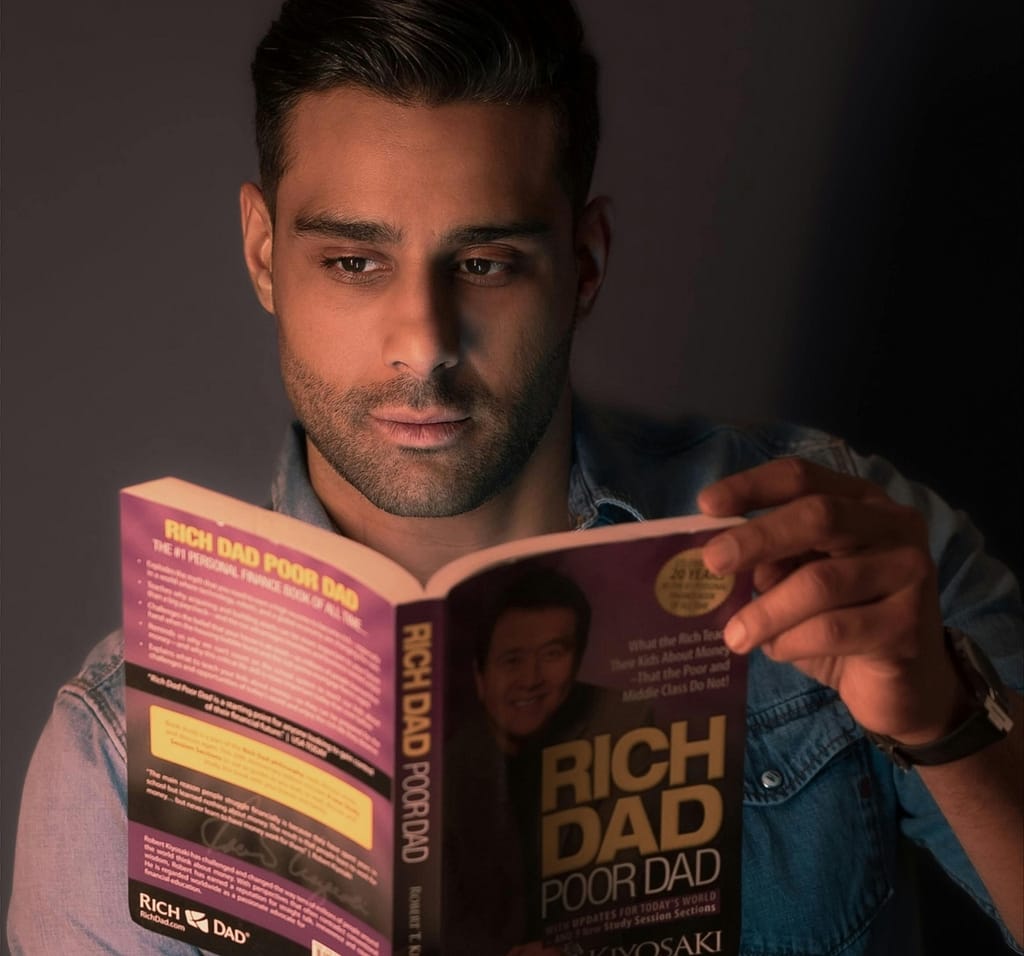
10. Rich Dad Poor Dad by Robert Kiyosaki
Goal: Reframe your understanding of assets, liabilities, and how wealth is actually built.
With over 32 million copies sold globally, “Rich Dad Poor Dad” is one of the most read personal finance books in history. Its central lesson is powerful and simple: wealthy people acquire assets (things that put money in your pocket), while everyone else acquires liabilities (things that take money out). Kiyosaki argues that the path most people follow, get a good job, buy a house, save money, is the path to financial mediocrity, not wealth.
Critics have raised valid concerns about some of Kiyosaki’s specific investment advice, and his financial figures have been questioned. But the mindset shift the book creates around assets versus liabilities is genuinely transformative for most readers. Read it for the framework, not as a literal investment playbook.
Best for: Anyone stuck in the “work harder for money” mindset who needs a paradigm shift.
Key takeaway: Your financial education matters more than your income level.
11. The Millionaire Next Door by Thomas J. Stanley and William D. Danko
Goal: Understand the real habits, behaviors, and lifestyles of wealthy Americans.
Stanley and Danko spent years conducting in-depth research on millionaires across America. Their findings surprised almost everyone: most millionaires don’t live in mansions or drive luxury cars. They live below their means, avoid lifestyle inflation, invest consistently, and build wealth quietly over decades. The book is essentially academic research translated into highly readable, actionable insight.
Best for: Readers who want data-backed habits from real wealthy people, not celebrity finance gurus.
Key takeaway: Wealth is what you don’t spend, not what you earn.
12. Your Money or Your Life by Vicki Robin and Joe Dominguez
Goal: Redefine your relationship with money and time to achieve financial independence.
This book is the foundational text of the FIRE movement (Financial Independence, Retire Early). Vicki Robin asks a question that most people never seriously consider: how much of your life energy (your time, health, and freedom) are you trading for each dollar you earn? The book walks you through a nine-step program to align your spending with your real values and build toward financial independence.
It’s less conventional than the other books on this list and more philosophical. But for readers who sense that the standard financial path isn’t working for them, it’s one of the most important books they’ll ever read.
Best for: Readers questioning the traditional work-spend-retire model and wanting an alternative.
Key takeaway: Financial independence isn’t about being rich. It’s about having enough.
How Do You Pick the Best Personal Finance Book When You’re Just Starting Out?
The fastest way to choose the right personal finance book as a beginner is to identify your single biggest money problem right now, then match it to the goal-based sections of this guide. Don’t start with the most popular book. Start with the most relevant book. One well-matched book you fully apply is worth more than ten books you only partially read.
Here’s a simple decision framework:
Step 1: Name your biggest money problem right now.
Be honest. Is it debt? No budget? No savings? Never invested? Feeling stuck despite decent income?
Step 2: Match the problem to a section.
Use the table below to find your starting point.
Step 3: Commit to one book and take one action.
Don’t move to the next book until you’ve implemented something from the current one. This is the rule almost every serious finance reader breaks and it’s the main reason book knowledge never becomes financial progress.
All 15 Books at a Glance: Ranked by Financial Goal
| # | Book | Author | Financial Goal | Difficulty |
| 1 | The Total Money Makeover | Dave Ramsey | Debt elimination | Beginner |
| 2 | Debt-Free Forever | Gail Vaz-Oxlade | Debt + budgeting | Beginner |
| 3 | The Index Card | Olen and Pollack | All-in-one simplicity | Beginner |
| 4 | I Will Teach You to Be Rich | Ramit Sethi | Budgeting and automation | Beginner |
| 5 | You Need a Budget | Jesse Mecham | Zero-based budgeting | Beginner |
| 6 | The Automatic Millionaire | David Bach | Automated saving | Beginner |
| 7 | The Psychology of Money | Morgan Housel | Investing mindset | Beginner |
| 8 | A Random Walk Down Wall Street | Burton Malkiel | Investment theory | Intermediate |
| 9 | The Little Book of Common Sense Investing | John C. Bogle | Index fund investing | Beginner |
| 10 | Rich Dad Poor Dad | Robert Kiyosaki | Wealth mindset | Beginner |
| 11 | The Millionaire Next Door | Stanley and Danko | Wealth habits | Beginner |
| 12 | Your Money or Your Life | Vicki Robin | Financial independence | Intermediate |
| 13 | The Richest Man in Babylon | George S. Clason | Foundational money principles | Beginner |
| 14 | Money: Master the Game | Tony Robbins | Comprehensive wealth strategy | Intermediate |
| 15 | The Simple Path to Wealth | JL Collins | Long-term index investing | Beginner |
Books 13-15: Honorable Mentions Worth Your Time
The Richest Man in Babylon by George S. Clason teaches timeless financial principles through ancient Babylonian parables. It’s one of the oldest personal finance books in print and one of the most beginner-friendly. The core lessons, pay yourself first, live below your means, and make your money work for you, haven’t changed in 100 years because they work.
Money: Master the Game by Tony Robbins is a long, dense book, but it contains some of the most valuable investing interviews ever compiled. Robbins spent years interviewing 50 of the world’s top financial minds including Ray Dalio and Jack Bogle. The book distills their advice into an actionable framework for regular people. Read it after you’ve completed one of the beginner books above.
The Simple Path to Wealth by JL Collins is the clearest, most practical guide to index fund investing for financial independence available today. Collins writes with unusual clarity and honesty. His core message: invest in low-cost total market index funds, avoid debt, and don’t overcomplicate it. It pairs perfectly with Bogle’s “Little Book” and our own beginner’s guide to investing.
One more thing worth mentioning here: books are powerful, but they’re not the only tool available to you in 2026. Modern AI tools for personal finance can help you apply the principles from these books in real time, from building budgets to tracking net worth to analyzing spending patterns. The combination of foundational book knowledge and modern AI assistance is genuinely powerful for anyone serious about financial progress.
There’s a pattern I’ve noticed consistently in how people approach personal finance books. The ones who make the most progress aren’t the ones who read the most. They’re the ones who read one book, apply the core lesson, see a result (even a small one), and then move to the next. The people who read fifteen books in a row and feel “ready” often end up in analysis paralysis. Don’t let the learning become a substitute for the doing. These books are tools. Pick one up. Use it.
Conclusion
The best personal finance books for beginners in 2026 aren’t the ones with the most five-star reviews. They’re the ones that match where you are right now and push you to take one concrete action this week.
Here are the three things to take away from this guide.
First, identify your biggest money problem before you buy a single book. The goal-based framework in this post exists so you can skip straight to the section that matters most to you right now.
Second, read one book all the way through and apply at least one lesson before moving on. That single habit separates the people who build real financial momentum from the people who collect self-help books.
Third, remember that books are the starting point, not the finish line. Apply what you learn, revisit this guide as your financial goals evolve, and explore everything we cover around winning in the digital economy here at Rejoice Winning.
Financial literacy is a competitive advantage. In a world where nearly half of American adults can’t answer basic money questions correctly, the people who commit to learning and applying solid financial principles are the ones who come out ahead. Start today. Start with one book. Then go win.
Frequently Asked Questions
1. What is the single best personal finance book for a complete beginner in 2026?
“I Will Teach You to Be Rich” by Ramit Sethi (2nd Edition) is the best all-around personal finance book for most beginners in 2026. It covers budgeting, debt, saving, and investing in accessible language with a six-week action plan you can start immediately. If you’re carrying significant debt, start with “The Total Money Makeover” by Dave Ramsey instead, since it’s specifically designed around debt elimination and financial recovery.
2. How many personal finance books should a beginner read per year?
Quality and application matter far more than quantity. Most financial experts and experienced readers recommend fully implementing the lessons from one book before starting the next. Two to four books per year, fully applied, will produce dramatically better results than reading a book a month and retaining very little. The goal is financial progress, not a long reading list.
3. Is “Rich Dad Poor Dad” still worth reading for beginners in 2026?
Yes, for the mindset shift it creates around assets and liabilities. Robert Kiyosaki’s core framework (acquiring assets that generate income rather than liabilities that drain it) remains genuinely valuable for beginners who haven’t thought deeply about wealth building. However, don’t treat it as a literal investment guide. Some of Kiyosaki’s specific advice has faced criticism, and the book works best when paired with a more practical and structured resource like “I Will Teach You to Be Rich.”
4. What is the difference between a budgeting book and a wealth-building book?
A budgeting book teaches you how to manage and control the money you currently have. A wealth-building book teaches you how to grow your money over time and shift your financial identity from earner to builder. Beginners almost always need to start with a budgeting book first. Trying to build wealth without a working budget is like trying to fill a bucket that has holes in the bottom. Once your cash flow is under control, wealth-building books give you the framework to accelerate.
5. Do personal finance books actually help people improve their financial situation?
Yes, when the education matches the reader’s current reality. The National Endowment for Financial Education has found that financial education produces measurable improvements in savings behavior and debt management. The key variable is relevance: a beginner who reads a book matched to their specific financial challenge is significantly more likely to take meaningful action than one who reads a generic bestseller that doesn’t connect to their situation. That’s the entire premise behind this goal-based guide.

Chalchisa Dadi is the founder of Rejoice Winning — a platform built for ambitious people who refuse to be left behind in the digital economy. With over a decade of hands-on experience analysing and implementing business plans for both private and public enterprises, Chalchisa brings a rare combination of strategic depth, real-world execution, and analytical precision to every piece of content published on this site.
Holding a verified certification in Data Analysis and Artificial Intelligence Fundamentals from Udacity, Chalchisa sits at the intersection of business strategy, financial intelligence, and emerging technology — the exact three pillars that power Rejoice Winning. Every insight shared here is grounded in years of working directly with organisations to turn ideas into measurable, sustainable results.
Chalchisa created Rejoice Winning with a single conviction: that winning in the digital economy is not reserved for the privileged few. It is a deliberate outcome available to anyone willing to learn strategically, move decisively, and build consistently. That mission drives every article, every guide, and every resource published on this platform.