Digital Transformation Leadership Guide: How Modern Leaders Drive Successful Change in 2026
TL;DR: Digital transformation leadership is the defining skill of the 2026 business landscape. Most transformations fail because leaders chase technology instead of building culture, strategy, and people-first change. This guide breaks down what effective digital leaders do differently, the frameworks that drive real results, the metrics that matter, and the exact mistakes to avoid. If you’re serious about winning in the digital economy, this is your practical playbook.
Most leaders know they need to transform. Very few know how to lead that transformation without burning out their teams, wasting their budgets, or stalling halfway through.
Here’s the number that should stop you in your tracks: 70% of digital transformations fail to meet their objectives, according to McKinsey. That’s not a small margin of error. That’s the overwhelming majority.
And yet, the transformations that do succeed share a clear pattern. They have leaders who approach digital transformation leadership not as a technology project, but as a people-first, strategy-driven movement. They align vision with execution. And they bring their teams along for the ride instead of dragging them forward.
This guide is built for leaders who are serious about being in that winning minority. We’ll cover what digital transformation leadership actually means in 2026, why most efforts fall short, what the best leaders do differently, and how you can build and measure a transformation strategy that delivers real results.
Let’s get into it.
What Is Digital Transformation Leadership?
Digital transformation leadership is the ability to guide an organization through the strategic, cultural, and operational shift from traditional ways of working to digital-first models. It goes beyond implementing new software. It means aligning people, processes, and technology to create lasting competitive advantage in a fast-moving digital economy.
This definition matters because most organizations confuse digital transformation with digital adoption. Installing a new CRM or moving files to the cloud is not transformation. Transformation happens when the way your entire organization thinks, operates, and delivers value changes fundamentally. If you want a clear breakdown of where this process begins, our guide on what digitalization really means is the best place to start.
Gartner research shows that by 2026, 75% of organizations will treat digital transformation as core to their overall business strategy. That’s not a trend anymore. That’s the baseline expectation.
And Market Us data confirms that 91% of businesses are already engaged in some form of digital initiative. The question isn’t whether to transform. The question is whether you have the leadership capacity to do it well.
If you’re just getting started, our practical guide on how to digitalize your business walks you through the foundational steps before you scale your transformation efforts.
What Makes Digital Transformation Leadership Different from Traditional Leadership?
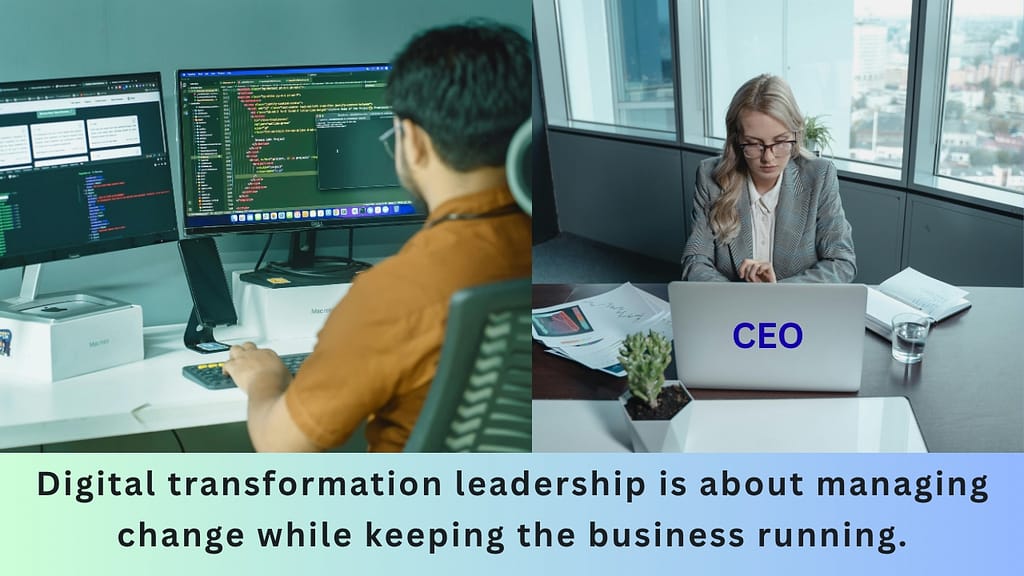
Traditional leadership is about managing stability. Digital transformation leadership is about managing change while keeping the business running. You’re essentially rebuilding the engine while the plane is in the air.
Here’s what that looks like in practice:
- Traditional leaders optimize existing processes.
- Digital transformation leaders question whether those processes should exist at all.
- Traditional leaders react to market shifts.
- Digital transformation leaders anticipate them and build systems that adapt.
The scope of digital transformation leadership covers four interconnected dimensions:
| Dimension | What It Involves |
| People | Upskilling teams, managing change resistance, building digital culture |
| Process | Redesigning workflows, automating repetitive tasks, eliminating bottlenecks |
| Technology | Selecting and integrating the right digital tools and platforms |
| Strategy | Aligning transformation efforts with long-term business goals and financial outcomes |
Great digital leaders hold all four dimensions in view at once. That’s what separates those who drive real change from those who just launch initiatives.
Why Do Most Digital Transformations Still Fail in 2026?
Most digital transformations fail because leaders treat them as technology projects instead of organizational change initiatives. The root causes are almost always cultural resistance, unclear vision, lack of executive alignment, and poor change management. Technology is rarely the problem. People and leadership almost always are.
That 70% failure rate from McKinsey isn’t just a shocking statistic. It’s a diagnostic tool. When you dig into why transformations fail, the pattern becomes clear.
PwC’s Digital IQ research found that only 26% of transformation initiatives achieve their intended ROI. Think about what that means. Three out of four organizations spend enormous time, money, and energy on transformation and don’t get the return they expected.
The Real Reasons Transformations Stall
1. Leadership misalignment at the top
When the C-suite isn’t unified on the vision and direction, mixed messages flow down through the organization. Teams get confused. Priorities shift. Momentum dies.
2. Culture eats strategy for breakfast
This phrase is older than most digital tools, but it’s never been more relevant. You can have the best technology stack in your industry and still fail if your organizational culture resists change at every turn.
3. Underestimating the human element
Most transformation budgets are heavily weighted toward technology. The people side, including training, communication, and change support, gets a fraction of the investment it needs.
4. Lack of a clear success definition
Many organizations launch transformation initiatives without defining what “done” looks like or how they’ll measure progress. Without clear targets, every milestone feels arbitrary.
5. Initiative fatigue
Organizations that stack too many transformation projects simultaneously exhaust their people. Fatigue kills execution. Execution is everything.
The good news? Every single one of these failure modes is solvable. And solving them starts with the right kind of leadership.
The 5 Core Traits of Effective Digital Transformation Leaders
We’ve studied transformation successes and failures closely, and the same leadership traits show up on the winning side every single time. These aren’t soft skills. They’re strategic competencies that directly influence whether your transformation delivers results.
1. Vision Clarity
Harvard Business Review research found that leaders who communicate a clear, compelling digital vision are 3.5 times more likely to outperform their industry peers. That’s not a marginal advantage. It’s a multiplier.
Vision clarity means your entire organization can answer one question without hesitation: “Why are we doing this, and where are we going?” If your people can’t answer that, your transformation is already in trouble.
2. Comfort with Ambiguity
Digital transformation doesn’t come with a guaranteed roadmap. Conditions change. New technologies emerge. Customer behaviors shift. Effective leaders make confident decisions with incomplete information, then adapt quickly when new data arrives. They don’t freeze when the path isn’t perfectly clear.
3. Customer Obsession
Forrester’s research shows that customer-obsessed companies grow revenue 2.5 times faster than their competitors. The best digital leaders never lose sight of who transformation ultimately serves: the customer. Every strategic decision filters through the question, “How does this improve the experience for the people we serve?”
4. Talent Prioritization
Transformation without the right people is just expensive experimentation. Strong digital leaders invest heavily in building internal capability. They recruit digital talent, develop it intentionally, and create environments where people can experiment, fail safely, and grow fast.
5. Data-Driven Decision Making
Gut instinct has its place, but digital transformation demands evidence. Effective leaders build systems that surface real-time data, use that data to make decisions, and hold themselves accountable to measurable outcomes. They don’t run on opinions. They run on insights.
These five traits aren’t exclusive to tech giants or Fortune 500 companies. We’ve seen them show up in mid-market firms and early-stage businesses that are serious about winning in the digital economy. The traits are learnable. They’re also non-negotiable if you want to lead transformation successfully.
How Do You Build a Digital Transformation Strategy That Actually Works?
A digital transformation strategy that works starts with a clear diagnosis of where you are, a specific vision of where you’re going, and a phased execution plan that connects technology investments to measurable business outcomes. Without that sequence, you’re spending money on tools that don’t connect to results.
Forbes confirms that digitally mature companies are 26% more profitable than their peers. But maturity doesn’t happen by accident. It follows a deliberate path.
Here’s the five-phase framework we recommend for building a transformation strategy that delivers:
Phase 1: Assess (Know Where You Stand)
Before you can transform, you need an honest picture of your current state. This means auditing your existing technology, processes, capabilities, and culture. Ask:
- Where are your biggest operational inefficiencies?
- What digital capabilities do you already have?
- Where are your competitors pulling ahead?
- What do your customers want that you can’t currently deliver?
Phase 2: Align (Get the Right People in the Room)
Transformation fails when it’s driven by one department or one executive. Real alignment means your leadership team, including finance, operations, HR, and marketing, agrees on the vision, the priorities, and their individual accountabilities.
This is also where you define success. Set clear, specific goals with timelines and assign ownership. Vague goals produce vague results.

Phase 3: Plan (Build the Roadmap)
A strong transformation roadmap is not a list of technology purchases. It’s a sequenced plan that connects each initiative to a specific business outcome. For a step-by-step breakdown of how to sequence your initiatives effectively, our digital transformation roadmap guide walks you through the full process from start to finish.
Prioritize quick wins that build momentum alongside longer-term structural changes. Consider two categories of initiatives:
| Category | Focus | Timeline |
| Quick wins | Visible improvements that build confidence and buy-in | 0-6 months |
| Strategic bets | Deeper structural changes with larger payoff | 6-24 months |
Phase 4: Execute (Move with Discipline)
Execution is where most transformations stall. Maintain a disciplined cadence: regular check-ins, clear sprint goals, and fast feedback loops. Empower teams to make decisions at the right level instead of pushing every choice to the top.
Phase 5: Optimize (Learn and Iterate)
Transformation is not a project with an end date. It’s an ongoing capability. Build regular review cycles into your strategy so you can measure what’s working, drop what isn’t, and double down on what drives results.
This framework applies whether you’re running a large enterprise or growing a digital-first business. The principles are consistent. The scale adjusts.
How Do You Lead People Through Digital Change?
Leading people through digital change means managing the emotional and practical reality of transformation alongside the strategic vision. People don’t resist change because they’re difficult. They resist it because change feels threatening. Effective digital leaders reduce that threat by communicating clearly, involving people early, and making the path forward feel achievable.
BCG research found that 80% of the value in a digital transformation comes from people and process changes, not the technology itself. That’s a critical insight. The tools matter, but the humans matter more.
And Deloitte’s transformation research backs this up: organizations with strong change management practices are 6 times more likely to succeed in their transformation efforts.
Why People Resist Digital Change
Understanding resistance is the first step to overcoming it. People resist digital change for a few consistent reasons:
- Fear of job loss from automation and AI
- Lack of confidence in using new tools or processes
- Loss of familiarity with how work used to get done
- Distrust of leadership if past change initiatives failed
None of these are irrational. They’re human responses to uncertainty. Your job as a leader is to address them directly, not dismiss them.
Practical Change Leadership Strategies
Communicate early and often. Don’t wait until the rollout to explain what’s happening. Bring people into the conversation during the planning phase. Transparency builds trust. Silence builds rumors.
Build internal champions. Identify respected people at every level of the organization who believe in the transformation vision. These “digital champions” become your most powerful change agents because they speak the language of their peers.
Invest in training before you need it. Upskilling programs should start before new tools go live, not after. People perform better with new systems when they’ve had time to practice in a low-stakes environment.
Celebrate progress loudly. Every milestone, every small win, is a data point that proves the transformation is working. Leaders who acknowledge progress publicly keep momentum alive.
This is the part of transformation leadership that doesn’t show up in most tech roadmaps. But it’s the part that determines whether your people carry the change forward or quietly wait for it to blow over. If your team is navigating resistance around process redesign and automation, our workflow automation strategies guide gives you a practical framework for making those transitions smoother.
Measuring What Actually Matters in Digital Transformation
Measuring digital transformation success means tracking metrics that connect directly to business outcomes, not just technology adoption rates. Vanity metrics like “number of tools deployed” or “employees trained” tell you activity happened. The metrics that matter tell you whether transformation is creating real value.
For a comprehensive breakdown of exactly which KPIs to track and how to report them to stakeholders, our guide on how to measure digital transformation success gives you the full framework. Here’s a practical overview across four key dimensions:
Financial Metrics
| Metric | What It Measures |
| Revenue growth from digital channels | Direct business impact of transformation |
| Cost savings from automation | Operational efficiency gains |
| ROI on technology investments | Financial return on transformation spend |
| EBITDA margin improvement | Overall profitability impact |
McKinsey’s research shows that companies that fully digitize their operations see 20 to 30% higher EBITDA margins than their less-digitized competitors. That’s the financial case for transformation, and it’s compelling.
Operational Metrics
- Process cycle time reduction
- Error rates before and after automation
- Time-to-market for new products or features
- System uptime and digital reliability
Customer Metrics
- Net Promoter Score (NPS) changes over the transformation period
- Customer effort score (how easy is it to do business with you?)
- Digital channel adoption rates among customers
- Customer lifetime value trends
Employee Metrics
- Digital skill assessment scores pre and post training
- Employee engagement scores during transformation
- Adoption rates of new tools and platforms
- Internal promoter scores related to transformation initiatives
The key principle here is simple: measure what connects to outcomes, not just what’s easy to count. If a metric doesn’t tell you whether your transformation is working, it probably doesn’t belong on your dashboard.
AI and Emerging Technology: What Digital Leaders Need to Know in 2026
This isn’t a section about which AI tool to buy. This is about what every serious digital transformation leader needs to understand about how AI and emerging technology are reshaping the transformation landscape itself.
IDC projects that global spending on digital transformation will reach $3.9 trillion by 2027. A significant and growing portion of that investment is flowing into AI, automation, and intelligent systems. Leaders who don’t understand these technologies well enough to make strategic decisions about them will be at a serious disadvantage.
What AI Changes About Digital Transformation Leadership
AI doesn’t just automate tasks. It changes the economics of entire business models. Here’s what that means for how you lead:
Decision-making gets faster. AI systems can surface insights from data in real time that used to take weeks of analysis. Leaders who use this capability well make better, faster decisions. Leaders who ignore it fall behind.
Workforce dynamics shift significantly. The World Economic Forum estimates that while automation may displace certain roles, 97 million new jobs will be created by the technology transition. Your job as a leader is to help your organization navigate that shift, not resist it.
AI governance becomes a leadership responsibility. As AI tools proliferate, questions about data privacy, algorithmic bias, and responsible use land on the leader’s desk. You don’t need to be a data scientist, but you do need a framework for ethical AI adoption. Our AI governance and ethics explainer gives you that foundation in plain language.
Competitive advantage compresses. Technologies that used to take years to deploy now take months or weeks. Your transformation strategy needs to be built for speed without sacrificing safety or quality.
Where AI Delivers the Most Transformation Value
Before committing budget to AI tools, leaders need to know where AI actually moves the needle. Our guide on business problems AI can solve breaks down the highest-impact use cases across operations, customer service, finance, and marketing.
And if you want to understand what this shift looks like at an industry level, our analysis of how AI is changing industries in 2026 gives you the context to make smarter strategic bets for your specific sector.
A Practical AI Leadership Framework for 2026
Before adopting any AI tool or platform, run it through these four questions:
- Does it connect to a specific business outcome? If you can’t name the outcome, don’t buy the tool.
- Do your people have the skills to use it effectively? Adoption without capability is waste.
- Do you have a governance policy for it? Data, privacy, and ethics questions need answers before deployment.
- Can you measure its impact? If you can’t measure it, you can’t manage it.
The leaders who are winning with AI in 2026 aren’t the ones with the most tools. They’re the ones with the clearest strategy for how AI serves their specific business goals. That’s where the real competitive edge lives.
Conclusion
Digital transformation leadership isn’t about being the smartest person in the room when it comes to technology. It’s about being the clearest thinker when it comes to people, strategy, and outcomes.
Here are the three takeaways that matter most:
First, transformation fails when leaders treat it as a technology project. The real work is cultural, strategic, and human.
Second, the leaders who succeed build clear vision, invest in their people, and measure outcomes that connect directly to business performance.
Third, AI and emerging technology aren’t threats to good leaders. They’re multipliers. But only for leaders who approach them with strategy, not just enthusiasm.
The digital economy rewards those who move with intention. Not just speed. Not just ambition. Intention backed by the right frameworks, the right measurements, and the right leadership mindset.
If you’re serious about winning in this landscape, you’re in the right place. Rejoice Winning exists to give you the practical insights on winning in the digital economy that help you move faster and smarter than the competition. The playbook is here. The move is yours.
Frequently Asked Questions
1. What does a digital transformation leader actually do day-to-day?
A digital transformation leader spends their time aligning stakeholders, removing barriers to execution, and ensuring that transformation initiatives stay connected to business strategy. Day-to-day, this looks like facilitating cross-functional decision-making, reviewing progress metrics, communicating vision to their teams, and addressing cultural or operational roadblocks before they become crises. It’s less about managing technology and more about managing change at every level of the organization.
2. What are the biggest mistakes leaders make during digital transformation?
The most common mistakes are treating transformation as a technology deployment project, underinvesting in change management, failing to align the leadership team before launch, and not defining clear success metrics upfront. McKinsey research consistently shows that cultural and leadership failures, not technology failures, are the primary drivers of the 70% transformation failure rate. Leaders who address the human side of transformation first dramatically increase their odds of success.
3. How long does a successful digital transformation take?
There’s no universal timeline, but most comprehensive digital transformations take between two and five years to reach a stable, organization-wide state of digital maturity. Early quick wins can appear within the first three to six months and are important for building momentum and organizational buy-in. The broader structural and cultural shifts take considerably longer. Leaders who expect transformation to be a short sprint almost always run into serious problems when the pace of change becomes unsustainable.
4. What skills do you need to lead digital transformation?
The most critical skills for digital transformation leadership include strategic vision communication, change management, data literacy, cross-functional collaboration, and comfort with ambiguity. Harvard Business Review highlights that vision clarity alone makes leaders 3.5 times more likely to outperform peers. Technical depth is helpful but not required. The highest-value skill is the ability to connect technology investments to human behavior change and measurable business outcomes.
5. How do small and mid-sized businesses approach digital transformation leadership differently from large enterprises?
Small and mid-sized businesses actually have a structural advantage in digital transformation: they can move faster and implement change with less bureaucracy. The key difference is resource allocation. SMBs need to be more ruthless about prioritizing the two or three transformation initiatives that will generate the most business impact, rather than trying to match the broad transformation scope of a large enterprise. BCG research confirms that focused transformation efforts tied directly to business outcomes produce the highest returns regardless of company size.

Chalchisa Dadi is the founder of Rejoice Winning — a platform built for ambitious people who refuse to be left behind in the digital economy. With over a decade of hands-on experience analysing and implementing business plans for both private and public enterprises, Chalchisa brings a rare combination of strategic depth, real-world execution, and analytical precision to every piece of content published on this site.
Holding a verified certification in Data Analysis and Artificial Intelligence Fundamentals from Udacity, Chalchisa sits at the intersection of business strategy, financial intelligence, and emerging technology — the exact three pillars that power Rejoice Winning. Every insight shared here is grounded in years of working directly with organisations to turn ideas into measurable, sustainable results.
Chalchisa created Rejoice Winning with a single conviction: that winning in the digital economy is not reserved for the privileged few. It is a deliberate outcome available to anyone willing to learn strategically, move decisively, and build consistently. That mission drives every article, every guide, and every resource published on this platform.